
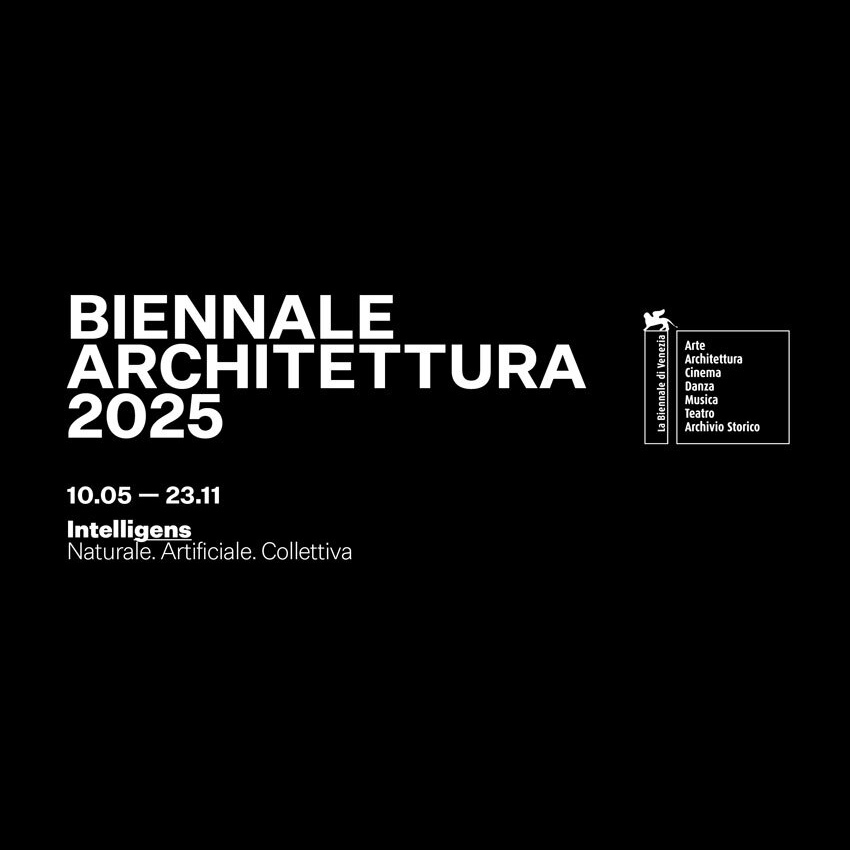
Under the title Intelligens. Natural. Artificial. Collective, the 19th Venice International Architecture Biennale, curated by Carlo Ratti—an architect, engineer, and professor at the Massachusetts Institute of Technology (MIT) and the Politecnico di Milano—opened to the public on May 10. At the heart of the 2025 Architecture Biennale are climate change and four new pavilions. “To confront a world on fire, architecture must harness all the intelligence that surrounds us,” says Carlo Ratti.
“For decades, architecture has responded to the climate crisis with mitigation: designing to reduce our impact on the climate. But this approach is no longer enough. It is time for architecture to shift from mitigation to adaptation: rethinking the way we design in light of a profoundly changed world. Adaptation requires a radical change in our practice. This year’s exhibition, Intelligens. Natural. Artificial. Collective, invites different types of intelligence to work together to rethink the built environment. “The very title of the exhibition, Intelligens, contains the Latin word gens (people in Latin) and invites us to experiment beyond the limits of a focus restricted to Artificial Intelligence and digital technologies,” continues Carlo Ratti.
“In the age of adaptation, architecture represents a central hub that must guide the process with optimism. In the age of adaptation, architecture must draw on all forms of intelligence: natural, artificial, and collective. In the age of adaptation, architecture must engage multiple generations and multiple disciplines, from the exact sciences to the arts. In the age of adaptation, architecture must rethink the concept of authorship and become more inclusive, learning from the sciences. Architecture must become flexible and dynamic, just like the world for which it is designing.” Ratti concludes with what is, to all intents and purposes, a true programmatic manifesto.
For the first time, the Architecture Biennale features over 750 participants: architects and engineers, mathematicians and climate scientists, philosophers and artists, chefs and programmers, writers and woodcarvers, farmers and fashion designers, and many others. Curating on such a large scale required a substantial shift in approach and mindset, achieved through a selection process open to everyone and driven from the ground up, guided by an interdisciplinary curatorial team. Through the open call Space for Ideas, open to anyone from May 7 to June 21 of last year, projects were collected from around the world and across various disciplines, allowing for the discovery of new and unheard voices that would otherwise have gone unnoticed.
As usual, La Biennale will take place at the Arsenale, the Giardini, and a series of collateral events held throughout the city.